Built by Raja Narsimhadeva of the Ganga dynasty, in the 13th century AD, the temple is the culmination of Orissan temple architecture. Lord Surya (Sun) is worshiped here. The temple resembles a colossal chariot, with 24 wheels pulled by seven straining horses, and has a three-tiered pyramidal roof topped off by a fine spire. It is said that, the very first ray of the Sun every morning falls upon this temple, from which it got its name.
Explore More
Popularly referred to as the Living Wonder, the Burj Khalifa holds the official record for being the world’s tallest building in the world. Located in downtown Dubai, this structure also described as a ‘Vertical City’ by many, has 160+ stories and took about six years to be completed. Having a total built up area of 5.67 million square feet, this amazing building includes residential spaces, office spaces as well as a luxury hotel. The architecture and engineering aspect was handled by Skidmore, Owings & Merrill LLP (SOM). The Spectacular Building DesignThe team borrowed heavily from traditional Islamic architecture to come up with the spectacular design used in this harmonious structure. The tower’s design is also inspired from the Hymenocallis, a lovely desert flower. Rather than choosing the traditional repetitive patterns, the architects chose to incorporate successively receding and rotated stories. The unique design allows spectacular outward views and excellent ventilation as well as natural lighting within. One interesting fact about the design is that the building design only incorporates vertical projecting elements in order to avoid dust build-up on the surfaces. Other Amazing TriviaThere are a total of 8 escalators and 57 elevators running across the length and breadth of the building. The structure requires 10 000 tons of cooling and its peak electrical requirement is 50 MVA that amounts to around 500, 000 of 100 watts light bulbs being used simultaneously.
Explore More
Tokyo Tower slumps in Shiba-koen district of Minato, Tokyo. It claims its name to fame as the second tallest structure in the country. Its structure is said to be inspired from Eiffel Tower. Tokyo Tower in Japan was built in the year 1958. People love to locate the scene of Tokyo from the tower. Functions Tokyo Tower functions as a broadcasting antenna support structure for both television and radio. It is also a popular tourist destination and has many attractions. Attractions for Tourists Tourists can make visit to FootTown, which is a four-story building. It slumps just under the tower. Visitors can have good time here savoring delectable food and enjoying shopping. There are also many museums and galleries located here, which can be explored. Visitors can use the elevators to reach two-story Main Observatory and Special Observatory. MaintenanceAfter every five years, Tokyo Tower is repainted. It takes twelve months to paint the tower. MascotsThe two mascots of the tower are two brothers who are named as Noppon. The elder brother can be spotted wearing blue dungarees, while younger brother can be spotted wearing red dungarees. Their birth date of the mascots is December 23, 1998.
Explore More
An interesting travel of about an hour by boat from the Gateway of India, passing the Mumbai harbour, and the Naval barges, takes you to Elephanta Caves where there are caves with carvings dedicated to Lord Siva. It is an UNESCO World Heritage site. The Elephanta Island is the site of the magnificent Elephanta caves, containing beautiful carvings, sculptures, and a temple to the Hindu God, Lord Shiva. The island of Elephanta, being a commercial, military and religions centre for centuries has traces of early Buddhist culture.One of the major Tourist Attractions of Maharashtra, the Elephanta Caves are situated near the metropolitan city of Mumbai. The Elephanta island is located 10 Kms away from the Gateway of India. There are various rock cut temples present in these caves, which are as old as 5th century. The Elephanta Island was named by the Portuguese, after the statue of an elephant near the landing area of the island. Construction of The Caves : The rock cut temples in Elephanta Caves are carved out of rock. There are columns, internal spaces and images within these temples. The entire temple is related to a large sculpture. In fact one can walk through the corridors and chambers of this sculptured temple. Created through a process of rock removal, the entire complex is an interesting monument. Some of the rock surfaces here are finely finished whereas some are unfinished bare rock. The Elephanta rock caves are sprawled over a large area of about 60000 square feet. These temple caves consist of a main chamber, courtyards and several subsidiary shrines. There is also a mass of natural rock, above the temple. There are three entrances to the temple. The eastern and the western entrances mark the axis of the temple. There is a 20 pillared hall that lines the axis, and on its western end is a cell in which a Shivalingam enshrined. The Mystical Images : The magnificent image of Sadasiva, a manifestation of Shiva, is carved in relief at the end of the north south axis. The stupendous 20 feet high image of the three headed Shiva, known as Trimurthy is a magnificent one. It is regarded as a masterpiece of Indian art. This huge image represents Panchamukha Shiva, whose only three faces are carved into the wall. It attracts your attention just as you enter the temple through the northern entrance. Along with this image there are grand sculptured images of Kalyanasundara, Gangadhara, Ardhanariswara and Uma Maheswara on the southern wall. Other sculptured images of Nataraja and andhakaasuravadamoorthy are to the west of the northern entrance and the images of Yogiswara and Ravanaanugrahamurthy are to its east.
Explore More
The Gandhi Ashram situated alongside the Sabarmati River, was the nerve center for the Indian Freedom movement. The beautiful ashram complex with it's shady trees offers a refuge from the loud streets of the city. There is a museum inside the Ashram complex. During the lifetime of Mahatma Gandhi it was known as Satyagraha Ashram.
Explore More
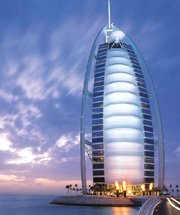
It all started with Sheikh Mohammed’s dream to create an iconic building that was to be the reflection of the glorious Arab heritage. The visionary leader wanted this structure to stand true to the famed Arab hospitality and be unprecedented in terms of luxury and extravagance. The result is of course the Burj Al Arab, the icon of Dubai. The iconic hotel resembles a yacht in water and is built on an island approx. 280 meters off the Jumeirah coast. Burj Al Arab is the tallest hotel in the world lying at the height of 321 meters above sea level & can be easily seen from almost any part of the city. This man-made wonder took about five years to get completed (1994-99). The Man Made IslandBurj al Arab is built on a man-made island on the offshore and is connected to the mainland by a walkway. Having a solid foundation comprising of large rocks, hollow concrete blocks and supported by 250 columns, the base extends to 45 meters below sea level. An All-Suite HotelThere are a total of 202 luxury duplexes and 28 double stories in this hotel & it tops the list of world’s finest 7 star hotels. Among the first of the unique high rise projects to be started in Dubai, Burj al Arab is seen as an international symbol for Dubai today.
Explore More
Adhai Din Ka Jhonpra is a remarkable structure of Indo-Islamic architecture said to have been built in two and a half days flat. This mosque was a Sanskrit college in the 12th century but in 1193 AD Mohammad Ghori destroyed the college and built a mosque in its place. It is built on pillars and surprisingly no two pillars are alike.The distinct pillars-and arched "Screen" with its ruined minarets make it a splendid architectural masterpiece. The monument has seven arched walls with Islamic calligraphy, though most of it now remains in ruins. "Adhai Din Ka Jhonpra" literally means "shed of two-and-a-half days". As mentioned earlier, a legend states that a part of the mosque was built in two-and-a-half days. Some Sufis claim that the name signifies a human's temporary life on the earth. According to the ASI, the name probably comes from a two-and-a-half-day-long fair that used to be held at the site. Har Bilas Sarda points out that the name "Adhai-Din-ka-Jhonpra" is not mentioned in any historical source. Before the 18th century, the mosque was simply known as a "Masjid" ("mosque"), since it had been the only mosque in Ajmer for centuries.
Explore More
Nestled in an inner fold of the Sahyadri hills, 100 kms away from Aurangabad are the 30 rock-cut caves of Ajanta, famous for its cave painting or frescoes of many colors. They contain numerous images of Buddha. Caves 1,2,16 and 17 have the best-preserved paintings. The magnificient depictions of the bodhisattvas Avalokitesvara and Padmapaniin are particularly well known. The Ajanta Caves are a World Heritage site cut from the volcanic lava of the Deccan in the forest ravines of the Sahyadri Hills. They are set in beautiful sylvan surroundings, providing a unique combination of architecture, sculpture and paintings.
Explore More
A suspension bridge, the Rainbow Bridge is a popular bridge located in Japan. It crosses “northern Tokyo Bay between Shibaura Pier and the Odaiba waterfront development in Minato, Tokyo”. Constructed from 1987 to 1993, it is 798 metres (2,618 ft) long bridge. The bridge got its name from public consensus. Rainbow Bridge in Tokyo is also referred as "Shuto Expressway No. 11 Daiba Route - Port of Tokyo Connector Bridge". Architecture The towers that support the bridge are white in color. The idea was that the bridge should harmonize with the central Tokyo’s skyline, which can be viewed from Odaiba. There are lamps on the wires that support the bridge. These add overwhelmingly to the beauty of the bridge. The lamps disperse light of three colors namely white, red and green. During night the view is spell bounding. The lamps are lighted with the aid of solar energy accumulated during day. How to Reach?One can reach the bridge by walking all the way from Tamachi Station (JR East) or Shibaura-fut? Station (Yurikamome). WalkwaysThe bridge is known to have two walkways. These can be traced on the lowers deck’s north and south sides. The north side is popular for depicting beautiful views of inner Tokyo harbour and Tokyo Tower. The south side is known for offering mesmerizing views of Tokyo Bay, and Mount Fuji. TimingsThe time for using the walkways is 9 am to 9 pm in the summer and 10 am to 6 pm in the winter.
Explore More
Universidade Federal de Santa Catarina
Located in Florianópolis, the capital of the city Santa Catarina, Universidade Federal de Santa Catarina is a public university known for the quality of courses it offers in Engineering. The university has several educational departments and is considered to be the third largest university in Brazil and sixth largest university in Latin America. Universidade Federal de Santa Catarina offers a wide variety of top quality courses in the field of mechanical engineering, control engineering, sanitary engineering, electrical engineering, dentistry and it is ranked as 4th best among all the universities in Latin America. University has been participating actively in the social, economic, political and cultural development of the country since its establishment in 1960. The enormous campus houses 11 different centers of education further divided into several departments. Universidade Federal de Santa Catarina offers 62 undergraduate courses, 48 Master courses and 33 doctorate courses to its students. The department which is known to be the largest of all is the Department of Mechanical Engineering. Universidade Federal de Santa Catarina is the only Federal University in the city of Santa Catarina and is renowned for its Engineering courses. Distance from Santa Catarina State - 260 Kilometers or 4 Hours
Explore More
An UNESCO declared World Heritage Site, Fort Jesus is located in Mombasa, Kenya, Africa. Built in 1591, it is a fort from the Portuguese era of Kenya. A magnificent combination of Portuguese, British and Arab architecture, Fort Jesus is a major tourist spot not only of Kenya but also of whole Africa. Fort Jesus is also an important place for research programs and many such activities.
Explore More
Situated in Pudong Park in Lujiazui, the Oriental Pearl Tower is the world sixth and China's second tallest TV and radio tower (468 meters). It is not only the height of this tower that attracts visitors but also its aesthetic beauty. The design is very unique and unlike most skyscrapers it has been made in oriental style architecture.It is encircled by the Yangpu Bridge to its northwest and the Nanpu Bridge to the southwest. When seen from above, this setting forms a picture of twin dragons playing with pearls. Millions of visitors flock to this picturesque place every year and travel up and down the tower in double-decker elevators. Upon reaching, the number of facilities and recreational activities are surely going to surprise you. There is a futuristic space city, a sightseeing hall, history museum and other such places of interest within each sphere of the tower. The revolving restaurant in the second sphere is a highlighted feature.Five spheres at the bottom are a hotel that comprises of twenty-five luxurious rooms and lounges. A visit to the Oriental Pearl Tower is a must while you are in Shanghai. Breathtakingly beautiful views it offers are surely going to stay in your memory forever.
Explore More
Nijo Castle was built after the draconian ruler Shogun Tokugawa Ieyasu usurped power and ordered all the feudal lords in Western Japan to in its construction. The place was the residence of the ruler in Kyoto. It has the ruins of the Honmaru Palace, the Ninomaru Palace, two concentric rings (Kuruwa) of fortifications, various several gardens and support buildings. The castle is spread over 275,000 square meters out of which 8000 square meters is taken up by buildings. The Castle is a popular tourist spot reckoned mostly for its painting, imagery and architecture that we made to reinforce the social control of Shogun Tokugawa. The emperor’s wealth was signified through the excellently finished gold walls and intricately designed lacquered ceiling shows. Even the pinewood used in the structure was a message to his haters that he will rule for long, as the wood is renowned for its longevity. Over the years, many have visited the Nijo Castle in Kyoto, Japan. The place is appreciated by one and all. Today, it is an ancient architecture considered one of the seventeen assets of Historic Monuments of Ancient Kyoto. Hence, it has become a must visit place for every tourist coming to Kyoto.
Explore More
Just outside the city, are located the 6th century caves displaying the influence of Tantric cult in the iconography and architectural designs of the caves. A major chunk of the caves are viharas, of which Caves 3 and 7 are most fascinating. These were excavated between the 2nd and 6th century AD. Tantric influences can be discerned in their architecture and iconography. There are twelve caves in all, a major chunk of which are viharas, of which Caves 3 and 7, are the most fascinating. Cave 3 stands supported by 12 finely carved columns, and sports sculptures portraying scenes from the Jataka tales. Cave 7 houses an imposing sculpture of a Boddhisattva, praying for deliverance. Some of the chaitya halls here are constructed on a mandala plan for the circumambulation of the Buddha who is depicted here seated on an intricately carved throne. A short walk from Bibi-Ka-Maqbara is a set of caves slighted by their more glamorous neighbours, Ajanta and Ellora. The western group consists mainly of viharas (monasteries) and depictions from the Jataka tales. At the eastern group, there are sculptures of scantily clad buxom women in freaky hairdos, child-eating goddesses, musicians and dancers alongside images of the Buddha. This is indicative of the rise of Tantric Buddhism during the 6th and 7th century A.D. Nestled amidst the hills are 12 Buddhist caves probably dating back to the 1 A.D. One is also treated to a panoramic view of the city as well as the imposing Maqbara from this point. These caves are carved out of the hillside and are a fine piece of architecture, housing the most stunningly intricate carvings.
Explore More
The Hole In The Wall, Eastern Cape, South Africa, is natural structure which is popular due to its detached cliff where a hole has been carved through its center. The thunderous claps of the waves on the structure can be often heard over large distances. The Hole In The Wall is also famous for a legend which it inspired. The legend speaks the story of a beautiful girl with whom one of the sea people became enamored. The sea people engaged a huge fish to batter a way through the rock wall so that the girl could be swept away.
Explore More
The Newtown Cultural Precinct is situated in Johannesburg, South Africa, and stands as a symbol for the re-inventions and redefinitions which the South African identity has gone through. The precinct is well linked with the nearby towns and is very popular due to the Market Theatre which is a renowned theater. The theater was an important entity during the period of apartheid due to its stress on non-racial theater.
Explore More
The drive to Lock Logan Waterfront from the Bloemfontein International airport takes only around 10 minutes. Spreading over 80,000 square meters, the Loch Logan waterfront is the largest shopping complex in the central parts of South Africa. There are over 27 food outlets and restaurants, around 100 shops, theaters, banks, gym, etc. Loch Logan Waterfront also has a medical center. It also serves as a central point for the tourists due to its proximity to other tourist attractions like Free State Rugby Stadium, the Bloemfontein Rose gardens, etc.
Explore More
The Roman Theatre, located in Alexandria, Egypt, is one of the rare Roman remains of Egypt. The marble seats and the mosaic- flooring are the proofs of Roman magnificence. With a capacity of 800 people, The Roman Theatre also served the purpose for wrestling matches and musical performances in the Ptolemaic times. The semi-circular white marble tiers on which the theatre is grounded are thirteen pieces of Europe imports. The columns are made of green Asian marbles and Aswan red granite. The geometric mosaic decorations on the wings of the both side of the stage are exceptionally beautiful. The Roman Theatre is surely a place to remember for visitors.
Explore More
The Unfinished Obelisk of Aswan, Egypt would have been the world’s largest standing obelisk, if the project had been completed. The Unfinished Obelisk is a proof of the grandeur of the Egyptian stone works. The obelisk was never detached from the bedrock. The massive size of the lying Unfinished Obelisk is an unforgettable sight of human intellect and imagination.
Explore More
“Colossal Endeavor, Brave Folly, Futile Contrivance, Or Splendid Achievement, The Great Wall Of China Inspires Awe” – National Geographic. This awe-inspiring structure arouses different sentiments in different people; no matter what kind of perception one has, The Great Wall Of China is one of the must-visit tourist places In Beijing. The Great Wall was originally a series of individual walls which were connected to form a single wall that stretches to approx. 21,196 km. The wall was originally built as far back as 7th century B.C to keep out invaders. Once the initial sections of the wall were built, it was added onto by numerous kings and dynasties that came later on. Designated as a World Heritage Site, some sections of the wall are more popular among tourists than others. Some Of the must-visit sections include: Badaling SectionThis is the most visited stretch & the sheer number of hawkers you find along this section will give you a fair idea regarding its popularity among the tourists. The renovated part of this wall is perfect for aged travelers and families as the climb is not too steep. Simatai SectionThis is one of the steepest and considered by many to be the most beautiful points across the entire wall. There is a lovely lake – Mandarin Duck Lake that divides the east and west side of the wall. The Fairy Tower (Tower 15) is acknowledged as the most beautiful tower along the entire stretch.
Explore More
The Ming Tombs can be reckoned as a collection of mausoleums. The beautiful tombs were constructed by Chinese Ming dynasty emperors. There are many Ming Tombs that straddle in groups near Beijing. These are colloquially referred as the Thirteen Tombs of the Ming Dynasty. The first among all tombs constructed is Ming emperor's tomb and is situated in close proximity to Nanjing. The tombs slump within Beijing’s suburban Changping District. Thoughtful PlanningThe site, the southern slope of Tianshou Mountain, where the tombs are located, was selected after a lot of though. The third Ming dynasty emperor relied on feng shui principles to select the site. The objective was to trick the bad spirits and evil winds, which come from the North, into changing their direction. Finally, a valley area characterized by arc-shape located at Jundu Mountains’ foot was chosen! The Imperial Palace’s work of construction got completed in the year 1420. The Yongle Emperor chose the valley his burial site too. He decided to build his own mausoleum here. The succeeding emperors also decided to build their tombs in the valley. One can see many statues, silk burning stove, Chinese Xin shaped jewelry etc. during ones visit to the Ming Tombs.
Explore More
Overlooking the mesmerizing Sharjah fountains, Al Majaz Waterfront is a premiere destination for tourists as well as the residents. The place offers a wide range of activities to revel in; splash park and play area are the favorites amongst the kids while adults here love to experience luxury at fine-dining restaurants and private boat cruise. Here are some of the major attractions of this place that you cannot afford to miss: Boat CruisePerfect way to spend the evening, these boats are a famous mode of transport that allow you to breathe in the beautiful landscapes of the Corniche area. The boats have been made in traditional Middle Eastern style to give you the complete Arab feel. Sharjah FountainThese are the biggest fountains in the Gulf with water jets soaring as high as 100 meters. Tourists can enjoy their multihued view from the nearby restaurants, cafes and bars or enjoy the magnificent fountain shows with a beautiful play of lights, sounds and the water. Spanning across an area of 220 meters, the sight of these fountains is surely going to leave you fascinated. Splash ParkThere is nowhere else your kids would want to be after coming to the Splash Park. In this 800 square meters of area, they get to splash under the waterfalls, explore the water tunnels and slides and watch the exquisite aquatic life flowing through.
Explore More
A symbol of the city Xian, the Bell Tower was built in 1384. Being a stately traditional building, it is well-persevered and maintained. In the olden days, the tower was used to mark the geographical center of the capital. Standing on a brick base, the wooden tower is 36 meters high. Numerous large bronze-cast bells are present in the tower. The architecture of the tower is a brilliant example of the Ming style architecture. The basic construction of the tower includes three layers of eaves with two stories. There is a staircase inside that spirals up. The square base is made of grey bricks and dark green glazed tiles cover the roof. There is mesmerizing gold-plating and gilded color painting on the roof makes the tower simply stunning. . The eaves not only add to the beauty of the tower but also reduce the impact of rain on the structure. During night, lanterns are used to illuminate the tower and thus making it even more memorizing. The entrance to the tower is through the spacious subway constructed under the tower. The area around the tower is planted with fragrant flowers and grass to create a peaceful environment. Modern shopping malls near the tower symbolize opulence of the city.
Explore More
One of the most famous landmarks, the Big Wild Goose Pagoda is situated in the southern suburb of Xian City. The Pagoda is located in the Da Ci'en Temple complex and attracts tourists and visitors all the year owing to its significance in the Buddhist religion and its Tang-style architecture. On June 22, 2014, the Pagoda was added to the World Heritage List. The pagoda was built to amass the Buddhist sutras brought back by monk Xuan Zang from India. The pagoda was initially constructed with five stories but later two additional stories were added. The present structure is 211.6 feet high and it is an architectural marvel. The simple yet brilliant design was made with bricks without using any cement. The classic style and somber appearance add to the beauty of the pagoda making it a brilliant example of traditional Chinese architecture. There are newly constructed open-air mall consisting of shops, restaurants and galleries to the south of the pagoda. One of the biggest attractions is Asia’s largest musical fountain at the North Square near the pagoda. It is well equipped with advanced lighting and audio systems. Besides, there are numerous parks and featured squares around the pagoda, which are very popular among tourists.
Explore More
Running through the town of Negombo is a canal, built by the Dutch, which presently serves as an important means of transportation as well as tourist attraction. Many private tour operators and hotels offer boat rides in this canal to show you around the city from a different perspective. The routeThe Dutch Canal covers a route of 120 kilometers passing from Colombo in the south to Negombo in the west and moves towards Puttalam in the north. On a boat ride here, you will be surrounded by mangroves on both the sides. There’s a good chance that you will spot many birds such as Herons, Cormorants, Kingfishers, and a variety of prey and perching birds. So don’t forget to take your cameras along for capturing the beautiful views of the journey. It is advised that you wear comfortable clothes, preferably in earthy colors. In the pastWhen the Dutch invaded this country in the mid-seventeenth century, they recognized the value of several lagoons crossing the lands and harnessed these water resources by building canals. During those days, the canals were used for carrying cargoes of precious gems, pearls and spices till the main sea port of Negombo for export.
Explore More
Arco de Teles is the perfect place to visit in Rio De Janeiro if you want to experience something out-of-the-ordinary in the city. Arco de Teles takes you back to the time of imperial Brazil. The charming and picturesque topography of Arco do Teles is a virtual feast for all the visitors. The feel of the place takes you to a different time in Rio. Architecture is quite unique compared to the nearby parts of downtown. Arco do Teles possesses most of the city’s cultural heritage. The name of the street is given on the name of the family of the builder Teles de Meneses. You will find city’s bars and restaurants here. During the day, the streets are full of people admiring the architectural heritage of the place and hanging out in bars with friends and family. Night is the perfect time to stroll down the streets of Arco de Teles with your friends, but if you want a real feel of the charming architecture and the nearby restaurants, day time is best. The streets give you a picture of how Rio must have looked back in 1910. The place is perfect to enjoy happy hours after work. Nearest Land Mark- Few Blocks away from Rio’s Financial Center.
Explore More
Luz Station was built to serve as headquarters for British-owned Sao Paulo Railway. The interior reflects the influence of classic late-Victorian style of architecture and was constructed in 1901 from material transported entirely from Britain. Back in 20th century, Luz Station was a symbol of both Brazil’s flourishing coffee plantation and its industrialization. The station was built by the famous British architect Charles Henry Driver and fell into disrepair in late 20th century. It was repaired and reopened in 2004 on the 450th anniversary of Sao Paulo city. Presently Luz Station serves as a railway station for the people of Sao Paulo connecting one main line that joins Santos Harbour to Jundiaí. Luz Station also houses a small but interesting museum known as Museu da Língua Portuguesa which exhibits the growth and evolution of Portuguese language since the ancient times. Luz Station is a perfect place to visit if you want to know more about Sao Paulo’s history. Till now a large number of Paulistas depend on Luz Station for their weekday commutes. The beautiful clock tower outside Luz Station sets the time for everyone in the city of Sao Paulo. Distance from Sao Paulo- 3 kilometers or 10 minutes.
Explore More
Theatro Municipal in Sao Paulo is considered to be a place of both cultural value and historical importance. It was constructed during the imperial times when opera was popular among the elite classes. The interior reflects the influence of Baroque and Neo Classical Architecture style. Located in the downtown area of Sao Paulo, Theatro Municipal is considered to be the best theatre in entire Brazil. The theatre was inaugurated back in 1911 with an act of Hamlet. The architecture has been inspired by the renowned Paris Opera House. The fine detailing and the grand staircase inside the Theatre look beautiful. A must go place if you want to witness the authentic culture perfectly blended with the modernist standards in Sao Paulo. Guided tours in English are also arranged for tourists on specific time of days inside Theatro Municipal. Visit to enjoy concerts, opera and ballet performances, you can book a ticket online or buy it from theatre’s ticket counter. You will get to see quality cultural performances at a very low ticket prices. Everything reminds you of the richness of Brazil’s imperial culture. Theatro Municipal is located in the heart of Sao Paulo and is one of the most visited tourist spot in the City. Distance from Sao Paulo- 4.9 Kilometers or 15 Minutes
Explore More
Centro Cultural Banco do Brasil Sao Paulo
Centro Cultural Banco do Brasil Sao Paulo is known to be one of the oldest centers in Sao Paulo and is famous for the quality of Art exhibitions, theatre and movie exhibitions that take place inside the Cultural Centre. Apart from the fine quality cultural exhibitions one should also visit to admire the beautiful architecture of the building. The building of Centro Cultural Banco do Brasil Sao Paulo is located in the heart of Sao Paulo. The best way to reach there is by taking a taxi or subway. The entry is absolutely free though, the center remains closed on Tuesdays. Centro Cultural Banco do Brasil Sao Paulo used to operate as a Bank till December, 1966. Now it houses many cultural facilities that include 2 theatres, a cinema and permanent exhibition of evolution of currency in Brazil. The cultural center is perfect destination for all art lovers. Centro Cultural Banco do Brasil Sao Paulo has one more branch in Rio de Janeiro, Brazil and is considered among the top hundred most visited museums in the world. Distance from Sao Paulo State- 2.5 kilometers or 10 minutes. Opening hour: Wed - Mon | 9am - 9pmClosing day: Tuesday
Explore More
Palais Du Peuple or People’s Palace, the seat of National Assembly and Senate of Kinshasa, Democratic Republic of Congo, was built by China in the years 1975 to 1979.
Explore More